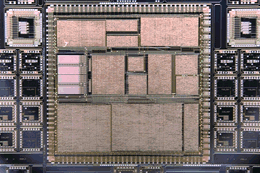
This is the SSS Online archive page where we store past reviews of IC chips used in Wireless,
Spread Spectrum and Digital Communications. For our most recent reviews, check out our
New SS Chips page.
Are you looking for a short range RF transceiver IC? I suggest that you give a close look
at the Xemics product line. Xemics is a fabless semiconductor
company which develops and delivers ultra low-power, short-range wireless connectivity ICs.
To visit their website, click on the logo below:
[Editor's Note: Xemics has been bought by
Semtech. See their
website for current product information. To the extent possible, links below have been redone to
direct you appropriately.]
Xemics is a spin-off from that formidable technology powerhouse CSEM in Switzerland.
Their products are starting to have quite an impact on the US market.
Their present offering in the RF chip lineup is the XE1201, a zero-IF FM transceiver that operates
in the 300MHz to 500MHz band. It has an innovative receive clock generation circuit so that
the received data is presented to your microcontroller with a synchronous clock. This eliminates
the need for the designer to perform clock generation in firmware or hardware.
For those of you in the US, they have an applications engineer that specializes in the
RF product line who is available for technical support. We have found this gentleman to be
very cooperative and eager to help.
Their microcontroller line is very interesting too. They have some of the lowest current consumption
micros out there. Operating on voltages down to 2.4V, they consume 300 microamps per MIPS! They also
have a US-based applications engineer dedicated to this line.
A neat new spread spectrum chip that is expected to be on the market in the fall of 2001 is the
Xemics XE1202 433/870/915MHz Low Power UHF Transceiver. This chip
will operate all the way from 433 MHz to 928 MHz using its integrated synthesizer. See the information
below for more specifics on this chip:
Transceiver chip description:
The XE1202 is a FSK one-chip transceiver circuit including both the RF front end and the baseband
processing section. It can operate in the 915 MHz, 870 MHz and 433 MHz ISM bands. The LO is
generated by a fully integrated frequency synthesizer allowing multi channel operations. Different VCO
tank tuning is used for cinfiguring the circuit operation in the chosen frequency band. This chip
will have applications in process & building control, security systems, wireless data link, home
appliances, remote control, and wireless sensing.
Transceiver chip data:
Part number: XE1202.
433/870/915 MHz
Transmit power up to +15 dBm
Supply voltage: 2.7 volt
Power consumption 12 mA (RX); 33 mA (TX, +5dBm)
Sensitivity: -113 dBm
Data rate: 76.8 kbits/s
Modulation: CP-FSK
BlueChip's Single Chip Frequency Hop Transceiver ICs (1998)
Editor's Note: BlueChip Communications was formerly Gran-Jansen AS. BlueChip Communication was acquired by Micrel Semiconductor Inc. in March, 2004.
The old Bluechip logo has been re-linked to the Micrel site; click below for more Information on their current chip lineup:
This just may be the chipset of choice for Ham Radio operators under the NEW TAPR SS STA
recently granted by the FCC!
Transceiver chip description:
BlueChip Communications AS offers a line of SINGLE
CHIP WIRELESS TRANSCEIVERS for radio-based frequency hopping spread spectrum communication.
The BCC 418 (300 - 600 MHz)and BCC 918 (700 - 1100 MHz) are single chip integrated circuits
for radio-based spread spectrum communication (FHSS). Both are ultra low power and zero-IF devices.
The circuit, which is easily applied, can
be utilised in homes, health care and industry in various ways such as WLANs, high security alarms,
2-way paging, telemetry, environmental control systems, wireless data repeaters, barcode readers,
and many more. A typical system consists of a microprocessor
and a transceiver plus a minimum of external components. These chips are pin
compatible and allow the user to utilize one motherboard.
Hams might add an RF Power Amplifier of a few Watts output, a little more receive front end low
noise amplifier gain and a good multi-element Yagi antenna and thus achieve RF line of sight
ranges of several miles!!!
IMEC has developed a range of flexible direct sequence spread
spectrum ASICs, for use in satellite communications and
terrestrial networks. The devices have been developed
in collaboration with SAIT Systems, a Belgium telecom company, and the
European Space Agency.
The family of spread spectrum chips currently available aims at niche
markets where highly reliable wireless communications are required, such
as industrial networks for monitoring and control.
The Programmable Mobile Communications Modem (PMCM) is a digital
transceiver chip integrating baseband and IF functionality with very low
implementation loss. Fully programmable spreader and correlator
functions, band-limiting oversampling filters and IF up-and
down-converters are on chip. The ASIC can process 10 Mchips/s and
incorporates an interface for an external processor for the
application-dependent functionality. The PMCM encapsulates a complexity
equal to 95,000 gates.
The PMCM provides a low cost and highly-miniaturized solution for
applications such as VSAT communications and terminals for Private Mobile
Radio networks via satellite. Code lengths of up to 1024 are supported.
The high processing gain also makes the PMCM a versatile key component
for wireless LAN applications where robustness of the link is crucial,
such as in industrial environments with high and unpredictable
interference levels.
The Advanced Spread spectrum Transceiver ASIC (ASTRA) is a high speed,
low power version of the PMCM, providing 15 Mchips/s, parallel
demodulation of 4 channels and a 32-bit interface to a host processor.
The Direct Sequence Integrated Receiver with ARM (TM) Core (DIRAC)
chip combines flexible and highly integrated IF receiver chain with an
on-chip 32-bit ARM microprocessor core. Cost effective spread spectrum
receivers, for satellite services for example, can be built using this
device.
A spread spectrum development kit built around the PMCM allows users
to explore programmable parameter ranges and to determine the parameter
set tuned towards a particular application.
A rapid design turnaround cycle - in the order of weeks - towards
customized components is possible due to the modular architecture of the
devices and the advanced CATHEDRAL CAD environment developed at IMEC.
Specification, synthesis and simulation at different abstraction levels
are all provided in an integrated toolbox. A link with the Synopsys,
Inc.'s (Mountain View, CA) design tools ensures compliance with
industrial standards of ASIC design. The design path is open to any
foundry.
A current development is the integration of digital, and analog modem
components in an MCM (Multi-Chip Module) package, which enables further
reductions in size and cost.
The next generation of ASICs will concentrate on high-speed operation
for markets such as wireless LAN, wireless multimedia and wireless office
products.
Editor's Note: IMEC was founded in 1984 and is headquartered in Leuven, Belgium. It is Europe's
leading independent research center for the development and licensing
of microelectronics, and information and communication technologies (ICT). IMEC
employs over 1000 people. Its 36,000 sq. ft. clean room is dedicated to
advanced research and development into semiconductor processing
technologies. IMEC's annual budget is more than 4.4 billion BF (103 million Euro).
Its revenue is derived from agreements and contracts with government agencies, aerospace
and semiconductor industry companies world-wide.
IMEC's activities concentrate on design of integrated information and communication systems;
silicon process technology; silicon technology and device integration; microsystems,
components and packaging; and advanced training in microelectronics.